


Frequently asked questions
- What is Tomatosphere?
- Why tomatoes?
- What type of seeds are involved in the project?
- Why are we studying seeds and plants for long-term space travel?
- Who are the Tomatosphere sponsors?
- Is Mars in the future for astronauts?
- What data will the students gather?
- What will the students do with the data?
- How long does the project take?
- What will students learn by participating in the project?
- My curriculum is really full. How can I squeeze this project into an already crowded curriculum?
- How will teachers be involved in the project?
- I home school my child. Can I be involved in Tomatosphere?
- I have a grade 12 class that I think could benefit from certain aspects of the program. Can I be involved, even though the grade level is up to grade 10?
- I am a family studies/home economics teacher. Can I register my class for this project?
- How do I as a teacher register my class for this project?
- I keep hearing about using Growing Spheres. What are they … how do they work … and where can I get them?
1. What is Tomatosphere
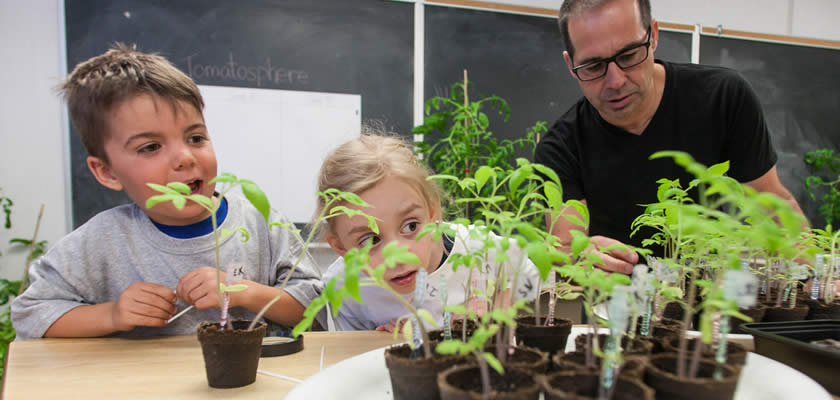
Tomatosphere is a research project that will involve about 15 000 Canadian classrooms this year. In 2013, students will have the opportunity to grow tomatoes from two sets of seeds. One set will be seeds which have been exposed to a process called priming and the other set will be the control group. In this research project, students will be asked to germinate the seeds, but the two sets will not be identified until their results are reported to the web site. This methodology, known as a "blind study" will allow the mystery of the project to be real for the students.
2. Why tomatoes?
Tomatoes are extremely versatile and nutritious. They have high levels of vitamin A and vitamin C and also contain lycopene, an ingredient that may help prevent certain cancers and cardiovascular disease. Tomatoes are included in Canada's Food Guide to Healthy Eating as part of the recommendation of five to ten servings of fruits and vegetables daily.
3. What type of seeds are involved in the project?
The seeds are a plum tomato type from traditional, conventional sources and have not been altered through any means (including biotechnology). They are a variety of seed from H.J. Heinz Canada - H9478 F1. This is a very versatile variety in that it can be used for tomato paste products, fresh juice, and whole peel. The plants will produce mature fruit in a period between 85 and 105 days depending upon growing conditions.
Teachers and students will not know the origin of the two different types of seeds used in the project until germination results have been submitted. This maintains the validity of the experiment.
One group of seeds is a control group; these seeds have had no special treatment. A second group of seeds have bee primed. In 2014, teachers who submit results in 2013 will have access to seeds brought back from the International Space Station after residing there for a period of 23 months.
4. Why are we studying seeds and plants for long-term space travel?
Food availability and life support are major limiting factors in extended space travel (Mars) and exploration. Plants will be needed to provide a source of fresh, nutritious food and to generate a vital life support system. The addition of oxygen and water as well as the removal of carbon dioxide to the closed environment aboard the space vehicle will be vital to the long-term mission. Currently scientists need to know how extended periods of time in space affects the germination and growth of plants.
5. Who are the Tomatosphere sponsors?
Tomatosphere is sponsored by the Canadian Space Agency, Heinz Canada Ltd, HeinzSeed, Stokes Seeds and the University of Guelph.
The sponsors provide both monetary and "in-kind" contributions to the project. Tomatosphere is indebted to the individuals and organizations that have come together from academia, government and the private sector to make this a successful project.
Teachers are encouraged to visit the web sites of the sponsors.
6. Is Mars in the future for astronauts?
Mars will be the next major global space program after the International Space Station and the establishment of a base on the Moon. Canada is positioning itself to play a signature role in the exploration of Mars and in the provision of life support and closed environment systems for space travel. Canada is also participating in the Aurora Project with the European Space Agency.
7. What data will the students gather?
There are opportunities for teachers to direct students to gather a variety of information about the tomato plants, their germination, vigour and growth patterns. However, the key element of the Tomatosphere research project focuses on the germination rates of the seeds that are planted. In addition to the amount of time that it takes for the seeds to germinated, we would like to know WHEN teachers have planted (actual dates are required) in order to determine more about the long-term effects of priming. More information is included in "Tips and Tricks" and in the teacher's manual.
The students will observe:
- The time required for each seed to successfully germinate.
- The number of successfully germinated seeds in each treatment.
As an option, teachers may wish to have their students collect data on:
- Seedling vigour as determined by height measurements. Some classes may continue to grow the seedlings out of doors, harvest the tomatoes … and even make “space salsa”!
8. What will the students do with the data?
Students will compile information, the teacher will send the results to the web site and the results will be combined with the other experiments across Canada. An automatic response will then convey which of the seeds were in each of the two seed packages. Students will be able to compare their class data with other classrooms; researchers at the University of Guelph will analyse the data and produce a national report.
In addition, teachers receive a certificate of participation for students in the class. The certificate is signed by former Canadian Astronaut, Dr. Robert Thirsk, and the principal investigator of the Tomatosphere Project, Dr. Michael Dixon from the University of Guelph.
9. How long does the project take?
The scope of the experiment will depend on the teacher, the interest of the students, and the amount of time available in the curriculum for this topic. The Tomatosphere Project Team recognizes the difficulties of covering large amounts of content for classroom teachers and has designed the project to match the curriculum requirements as outlined in the Pan-Canadian Science Curriculum Protocol document. This document has been used by provinces to create their individual (or grouped) science curricula. The project should be viewed as an integral part of the curriculum rather than an "add-on" to the curriculum.
Students will observe the process anywhere from seedling germination to full-grown tomatoes (approximately 3 months). The critical germination period is 1-3 weeks, and the growth period is about four to six weeks. Teachers may choose to focus ONLY on the germination part of the project; alternatively, the project can continue with observations about plant vigour and growth.
10. What will students learn by participating in the project?
Students will learn about the exciting world of science, space exploration, food and nutrition. The emphasis is on life support environments that are required in space. However, applications are also made to the sustainability of life here on Earth. There are separate lesson plans and student activities for grades 2-4, 5-7 and 8-10 in the teacher's guide (also available on this web site). The curriculum focus for each of these areas is related to the Pan-Canadian Science Protocol. For grades 2-4, the emphasis is on the plants, for grades 5-7, the focus is on space and living in space, and for grades 8-10, the central themes relate to space, energy and the environment.
In 2009, four new curriculum units were added to the web site. These are all optional units that the teacher can use to supplement the central study of the germination of the seeds.
11. My curriculum is really full. How can I squeeze this project into an already crowded curriculum?
The Tomatosphere Project has been designed to incorporate the curriculum concepts and skills from the Pan-Canadian Science Protocol. The Tomatosphere Project will allow teachers to engage a variety of science expectations as well as the opportunity to involve students in cross-curricular activities - careers, environmental studies, health and nutrition, mathematics... and even the arts.
12. How will teachers be involved in the project?
Teachers are the key contact persons for the project. The numbers have increased every year; in 2013, it is expected that there will be over 15,000 classrooms involved in the project.
Teachers will receive the seed packages in the spring of each year. Planting can take place either in the spring or the fall. Lesson plans, background information, curriculum connections and assessment suggestions are all included in the Teachers' Guide on the web site. For semestered schools, the project can take place in either the spring or the fall. Schools on a year-long program should germinate their seeds in the spring.
One of the key roles for the teacher is the submission of results to the project web site (www.tomatosphere.org - submit results). We ask that teachers do this task since the submission also involves assessment of the Tomatosphere Project.
13. I home school my child. Can I be involved in Tomatosphere?
Home schoolers are encouraged to work with others in the area and combine to form a "small class" that can be involved. This will ensure that our seeds and other peripherals are utilized to the best advantage for the project budget. It also provides an opportunity for students (home-schooled) to work in a group environment and to be involved in a team approach, much like the environment in which astronauts and other scientists work.
A group of home schooling families can plan and implement the project together and designate one family as the contact and register. The contact should register as a classroom teacher indicating the number of teachers as ONE and also indicating the number of students involved. The registrant will receive 40 of each type of seeds for the "class".
Tomatosphere finds it impossible this year to provide seeds to home schooling families outside of Canada on an individual basis. The costs of packaging and mailing make this part of the project cost prohibitive.
We apologize for the inconvenience; the decision on the part of the Project Team was made to allow as many students as possible to be involved in the project.
14. I have a grade 12 class that I think could benefit from certain aspects of the program. Can I be involved, even though the grade level is up to grade 10?
The curriculum-based activities for the Tomatosphere Project are based on the Pan-Canadian Curriculum guidelines for science. The curriculum links are BEST for grades 3-6 and grades 9-10. However, if YOUR program has a component which would benefit from a link with the project, and your students would benefit from this program, please register as a grade 10 class. A similar situation exists for teachers of kindergarten, grades one and two. Although the curriculum connections may not be exact, the process of germination will be interesting to younger children.
15. I am a family studies/home economics teacher. Can I register my class for this project?
The Tomatosphere Project focuses on science - biology, space, energy. However, we recognize that the project will be of interest to teachers in other areas as well, particularly those teachers teaching about the applications of science, including environmental studies, nutrition, and social studies. The curriculum connections and the assessment suggestions focus on science; consequently, teachers in other disciplines will have to create their own assessment instruments. The new units developed for phase three of Tomatosphere have strong connections to nutrition, energy, space and environmental studies.
16. How do I as a teacher register my class for this project?
We are now accepting registration for 2013 and 2014. Depending upon when you register, you will receive your seeds at different times. If you register before February 15, 2013, you will receive your seeds at the end of February; if you register between February 15 and March 15, you will receive your seeds at the end of March. If you register after March 15, you probably will receive your seeds within 10 business days of registration.
You can do the planting ANY TIME after you receive the seeds, but results should be submitted by the end of June (for spring planting) or the end of January, 2014 (for fall planting). The project involves automatic annual renewal for teachers (who are busy individuals). However, teachers always receive a notice in the fall and winter asking if they wish to be removed from the data base.
17. I keep hearing about using Growing Spheres. What are they … how do they work … and where can I get them?
Growing spheres or cubes (hydrophilic water gel) are small polymers that have a strong affinity for water – like a sponge absorbing water. They swell to about 300 times their size from about 3 mm in diameter to about 2.5 cm (1”) in diameter. By placing a seed in the sphere, students can actually see the germination process taking place – something students cannot see when the seed is placed in a peat pellets. For 2013, it is suggested that teachers use only a few of the seeds to experiment with the growing spheres AS AN OPTIONAL ACTIVITY. The growing spheres are available from a number of sources. They can be purchased from stores that sell floral accessories … occasionally even in “dollar” stores. There are several educational suppliers as well who carry these spheres. Check with your science equipment supplier for your school or board.
Tomatosphere is sponsored by the Canadian Space Agency, Heinz Canada Ltd, HeinzSeed, Stokes Seeds and the University of Guelph.

