


Media room
What is Tomatosphere?
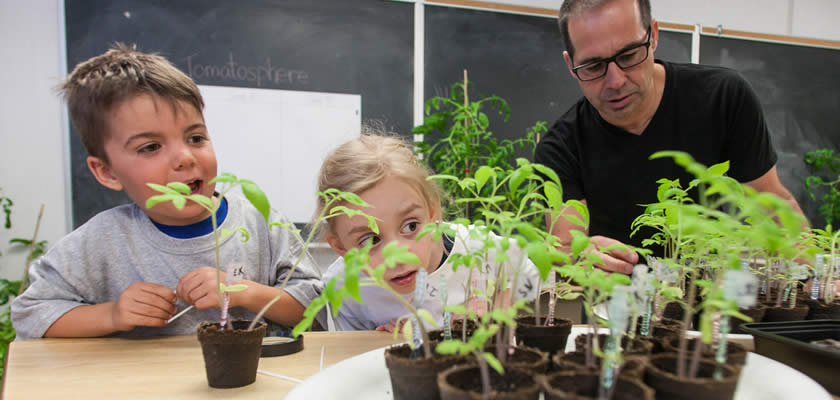
Tomatosphere is an educational outreach project involving more than 9000 classrooms in Canada (and the United States and several other countries). The project uses the excitement of space exploration as a medium for teaching students about science, space and agriculture and the role being played by Canada as a world leader in the support of long-term space flight.
The project began in 2001 and has expanded each year. In the spring of each year, classrooms in grades 2-10 conduct experiments to investigate the effects of the space environment on the growth of food (i.e. the tomato) that will inevitably be one of the many used to support a long-term human mission, establishing a base on the Moon, and then to Mars. In the spring of 2008, it is expected that, based on current registrations, the number of classrooms involved will exceed 10 000 for the first time in the history of the project.
In 2008, students will be dealing with two groups of seeds. One type of seed is a control group which will be used as a basis for comparison with the second set of seeds. The control group consists of Heinz H9478 seeds which have had no exposure to any extraneous conditions. The second set of seeds - also Heinz H9478 - has been exposed to a simulation of aerocapture that seeds will experience when entering the atmosphere of Mars. Aerocapture is a spacecraft maneuver that reduces the high point of an elliptical orbit by entering the atmosphere at the low point, using drag to slow the space vehicle. This maneuver saves fuel compared to the direct use of a rocket engine. Aerobraking puts the seeds under pressure and may increase the temperatures to which the seeds are exposed.
Students will conduct the germination experiment in a "blind" test; they will not know the treatment associated with each of the groups of seeds until they have completed the germination component of the experiment. This will prevent any unintentional bias from creeping into the results.
Purpose
The students' findings will begin to address the question of how we supply space exploration missions with life support requirements - food, water, oxygen and the need to consume carbon dioxide exhaled by the members of the crew. Currently, space-mission vehicles are able to carry just enough of these requirements to service the crew for short missions. Stays at the International Space Station are refreshed on a regular visit by supplies from Earth. Travelling to and from Mars, the closest planet to Earth, would take almost two and a half years.
In our quest to travel deeper into space for extended periods, we need to find ways to expand life support provisions in the limited confines of space vehicles. A plant-based life support system may provide part of the solution. Through photosynthesis, plants use light energy to consume carbon dioxide exhaled by humans and return oxygen to the air that is needed for survival. One of the most popular and valuable plants for space applications is the tomato. Tomatoes provide wholesome nourishment and purify water through evaporation from their leaves.
Exposing the seeds to a variety of environments will help researchers to determine if... and how... the seeds are affected by events related to space travel. This will help to determine what types of seeds have the highest potential for germination and growth in space - crucial to space missions where availability of physical space is a serious issue. Because space is so critical, the number of plants that can be grown and the number of people who can be supported for extended periods is limited. When a seed - and the plant that grows from it - is assigned to a space mission, it must sprout successfully and continue to grow healthy, strong and produce an abundance of fruit. Seeds that don't germinate, and plants that are weak and don't grow properly are not contributing to the mission. Weak plants may also become sick and spread their illness to other plants, causing even more problems to the controlled-environment system.
Students will compare the rates of germination of the control group and the seeds exposed to the simulation of aerocapture, and will report on the growth and development of the plants. Students will learn how to conduct a scientific experiment and may be inspired to pursue further education in the areas of science and technology. It is essential that we focus on the technical needs of ventures like the space program in order to motivate young people to pursue studies in science and technology. Not all students can become astronauts; however, many will be able to find significant, worthwhile roles in providing support for knowledge-based programs like that being developed by the Canadian Space Agency and others.
Tomatosphere is sponsored by Agriculture and Agri-Food Canada, the Canadian Space Agency, Heinz Canada, H.J. Heinz Company Foundation, Ontario Centres of Excellence, Stokes Seeds and the University of Guelph.

