


Canadian astronauts

Teacher resources

What is Tomatosphere?

Tomatosphere is an educational outreach project that reaches over 9000 classrooms across Canada, the United States and several other nations. In 2008, teachers of students in grades 2-10 will receive two packages of Heinz tomato seeds, with 30 seeds in each package. Home schoolers will receive two packages of Heinz tomato seeds, with 15 seeds in each package, labeled "A" and "B". One package of seeds is the control group - Heinz 9478 F1 seeds; the second package contains the same seeds but they have been subjected to conditions which simulate the process of aerocapture as the space vehicle enters the atmosphere of Mars. The effects include higher pressure and temperature. Aerocapture into Mars uses the friction of the martian atmosphere to slow the space vehicle down.

Purpose

Tomatosphere has a dual-purpose: to educate and inspire young students and to open the door for extended space exploration, eventually leading to Mars.

The students' findings will address the question of how we supply space exploration missions with life support requirements - food, water, oxygen and the need to consume carbon dioxide exhaled by the members of the crew. Currently, space-mission vehicles are able to carry just enough of these requirements to service the crew for short missions. Stays at the International Space Station are refreshed on a regular visit by supplies from Earth such as the Russian Progress and Soyuz flights and US flights. Travelling to and from Mars, the closest planet to Earth, may take in excess of two years.

In our quest to travel deeper into space for extended periods, we need to find ways to expand life support provisions in the limited room available in space vehicles. A plant-based life support system may provide part of the solution. Through photosynthesis, plants use light energy to consume carbon dioxide exhaled by humans and return oxygen to the air that is needed for survival. One of the most popular and valuable plants for space applications is the tomato. Tomatoes provide wholesome nourishment and purified water through transpiration from their leaves.

Seeds in space

By sending tomato seeds on a shuttle mission, exposing them to conditions which may reflect conditions experienced on a Mars mission, or having them housed at the International Space Station for an extended period of time, researchers can determine if and how the seeds are affected by environmental conditions. This will help to determine which types of seeds have the highest potential for germination and growth in space. Because space is so critical, the number of plants that can be grown and the number of people who can be supported for extended time periods, is limited. When a seed - and the plant that grows from it - is assigned to a space mission, it must germinate successfully and continue to grow healthy, strong and with an abundance of fruit. Seeds that don't germinate, and plants that are weak - and don't grow properly - are not contributing to the mission. Weak plants may also become sick and contaminate the controlled environment system.

Students will compare the rates of germination and may report on the growth and development of the plants from the seeds from the two different conditions. Students will learn how to conduct a scientific experiment and hopefully will be inspired to pursue further education in the areas of science and technology.

Curriculum focus

Grades 2-4: Students focus on plants and their growth patterns.

Grades 5-7: The emphasis is on human needs, weather and space.

Grades 8-10: Students will start with the seeds and complete their studies with an application of the benefits of space exploration, research and application to life on Earth.

How will the project proceed?

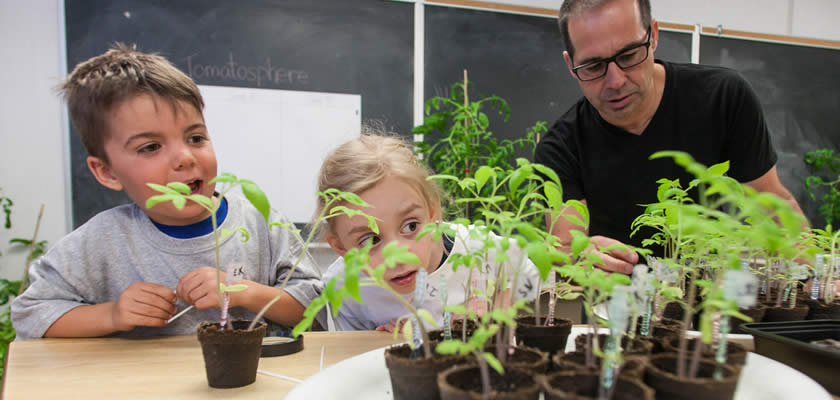
Students and thier teacherStudents will observe the tomatoes during their seedling germination and growth. The scope of the experiment will depend on the teacher; there are extension ideas that involve many aspects related to plants, space and space travel, and its application to life on Earth. However, the project focuses on the critical element of rate of germination, and for students in senior grades, observations on plant growth and vigour. All results will be sent electronically to the Tomatosphere website (submit your results) and will be posted to enable participants to compare their results with those of other classrooms across the country.