


Research on the International Space Station
Research in the station's six laboratories will lead to discoveries in medicine, materials and fundamental science that will benefit people all over the world. Through its research and technology, the station also will serve as a step in preparation for future human space exploration.
Examples of the types of research that will be performed aboard the station include:
Protein crystal studies: More pure protein crystals may be grown in space than on Earth. Analysis of these crystals helps scientists better understand the nature of proteins, enzymes and viruses, perhaps leading to the development of new drugs and a better understanding of the fundamental building blocks of life. Similar experiments have been conducted on the Space Shuttle, although they are limited by the short duration of Shuttle flights. This type of research could lead to the study of possible treatments for cancer, diabetes, emphysema and immune system disorders, among other research.
Tissue culture: Living cells can be grown in a laboratory environment in space where they are not distorted by gravity. NASA already has developed a Bioreactor device that is used on Earth to simulate the effect of reduced gravity. However, growing cultures for long periods aboard the station will further advance this research. Such cultures can be used to test new treatments for cancer without risking harm to patients.
Life in low gravity: The effects of long-term exposure to reduced gravity on humans will be studied aboard the station. The effects on humans include the weakening of muscles, changes in how the heart, arteries and veins work, and the loss of bone density. Studies of these effects may lead to a better understanding of the body's systems and similar ailments on Earth. A thorough understanding of such effects and possible methods of counteracting them is needed to prepare for future long-term human exploration of the solar system. Studies of the gravitational effects on plants, animals and the function of living cells will be conducted. A centrifuge will use centrifugal force to generate simulated gravity ranging from almost zero to twice that of Earth. This facility will imitate Earth's gravity for comparison purposes, and simulate the gravity on the Moon or Mars for experiments.
Flames, fluids and metal in space: Even flames burn differently without gravity. Reduced gravity reduces convection currents, the currents that cause warm air or fluid to rise and cool air or fluid to sink on Earth. This alters the flame shape in orbit and allows studies of the combustion process that are impossible on Earth. The absence of convection allows molten metals or other materials to be mixed more thoroughly in orbit than on Earth. Scientists plan to study this field, called Materials Science, to create better metal alloys for applications such as computer chips.
The nature of space: Some experiments aboard the station will take place on the exterior of the station modules. Such exterior experiments can study the space environment and how long-term exposure to space, the vacuum and the debris, affects materials. This research can provide a better understanding of the nature of space and enhance spacecraft design.
Fundamental Physics: experiments take advantage of weightlessness to study forces that are weak and difficult to study when subject to gravity on Earth. These experiments may help explain how the universe developed. In addition to investigating basic questions about nature, this research could lead to down-to-Earth developments that may include clocks a thousand times more accurate than today's atomic clocks, better weather forecasting, and stronger materials.
Watching the Earth: Observations of the Earth from orbit help the study of large-scale, long-term changes in the environment. The effects of volcanoes, ancient meteorite impacts, hurricanes and typhoons can be studied. Changes to the Earth caused by humans can be observed - smog over cities, deforestation, and oil spills - are visible from space and can be captured in images that provide a global perspective.
Commercialization: Industries will participate in research by conducting experiments and studies aimed at developing new products and services. The results may benefit those on Earth by providing innovative new products and by creating new jobs.
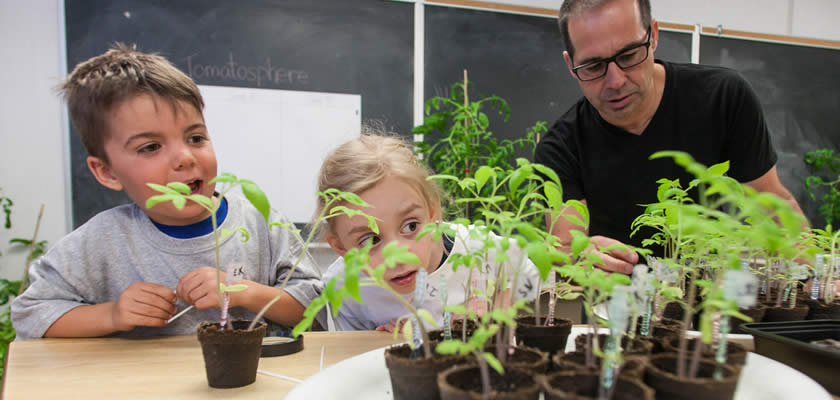
Tomatosphere is sponsored by Agriculture and Agri-Food Canada, the Canadian Space Agency, Heinz Canada Ltd, HeinzSeed, Ontario Centres of Excellence, Stokes Seeds and the University of Guelph.
Teacher Resources
- Tomatosphere Project Overview
- Tips 'n' Tricks
- NEW Seed Treatment for 2010
- 2010 Teachers' Guide
- PDF Resources [Printable charts from the Teachers' Guide]
- NEW Four Optional Units
- NEW Biological Life Support Systems
- Tomatosphere Supplies
- Tomatoes in Space [Video]
- Heinz Tomato Breeding Program
- International Space Station
- Astronaut Mike Fincke talks about the importance of Tomatosphere [Video]
- CSA Teachers' Conference
- CSA Teacher Resources
- Exploring Mars
- Mars Environment

