


Priming

Teachers may be unfamiliar with the concept of "priming" seeds. However, teachers understand the value of Early Childhood Education … and how it can influence later classroom experiences in the higher grades! Giving a child a good start in education is important; the same can be said for seeds. Priming seeds is like giving them a "better start" to life.

Another way of explaining this process has been developed by Keith Kubik, Ph.D. a Seed Physiologist with the Harris Moran Seed Company in California. Dr. Kubik compared seed priming to building a pre-fabricated house. Pre-fabricated houses are built INSIDE A FACTORY. The walls and roof are put together in an environment that is ideal for the workers – very important in our climate here in Canada - and building efficiencies are best. However, the house is not completed inside the factory. The pre-built walls and roof are taken to the building site where the remaining construction takes place – the electrical work, the plumbing, and the basic fixtures like countertops and inside trim. Less time is consumed at the site, and the houses go up more quickly and more efficiently.

Similarly, with seeds, the priming process starts the germination process in the laboratory. The basic chemical reactions or framework needed for the seed to germinate take place under ideal temperatures and high moisture conditions. The seed moisture is set so that the germination is ALMOST complete … just like the prefabricated house when it is moved onto the actual home site.

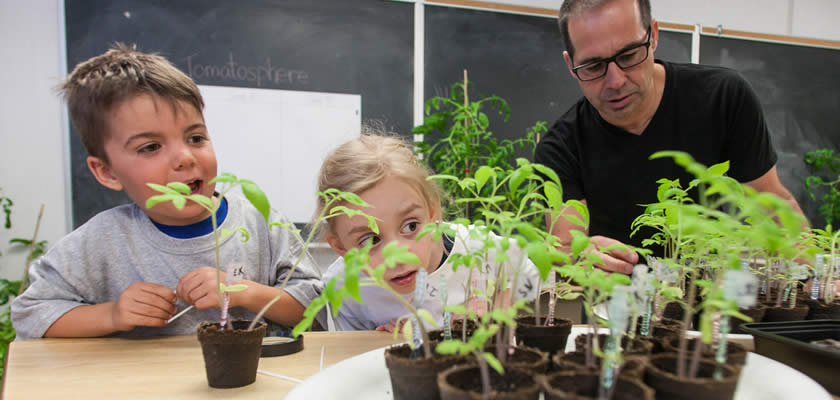
When you get your seeds, one of the two groups will be a control group and the other group will have been "primed" – almost ready for germination. Like the pre-fabricated house, seed germination of the primed seeds will probably take less time, because part of the germination process is already complete.

You will still report on the germination process – the number of seeds planted and number of seeds germinated.

In addition, we are asking you to record the DATE that the seeds were planted, and to take close note of the TIME that it takes your two sets of seeds (S and T) to germinate – how many days until the first germination, and how much time between the first and last germination…for each of the two groups.

Click here to link to the reproducible forms for the information that you will need to record and to have on hand when submitting results.

Additional Background Information

Priming is not a new idea; it has been going on for many years in developing nations. Farmers soak seeds to help the seeds get started in areas of semi-arid or arid conditions. The seeds are soaked in water for up to 18 hours and then planted; however, the seeds still need water to complete the germination process, so primed seeds requires moisture from the soil (or peat pot) after they have been planted.

If crops germinate and grow slowly, they may become stunted and spindly … and they may be more susceptible to diseases. Where the availability of water is an issue, the importance of getting a good start is particularly important. On long-term space voyages, and, perhaps on the surface of Mars, the availability of water may be a serious issue. If the amount of time to germinate is reduced, the focus can be placed on plant growth and vigour.

In addition, some studies have shown that there has been an increase in the range in temperature at which the seed can germinate. This may be of significance in northern climates and on space vehicles. Studies also reveal that priming can reduce the amount of seed-borne fungi and bacteria.

Primed seed usually emerges from the soil faster, and more uniformly than non-primed seed of the same seed lot. These differences are greatest under adverse environmental conditions in the field, such as cold or hot soils. Some growers use seed priming during the earlier plantings in cold soil, but not later in the season when conditions are warmer. Lettuce growers in the Southwest region of the United States use primed seed in the hottest part of the season, when lettuce may not be able to germinate due to the extreme heat. These growers switch back to non-primed seed during the cooler season.

One risk when using primed seed is reduced seed shelf life. Depending on the species, seed lot vigour, and the temperature and humidity that the seed is being stored, a primed seed should remain viable for up to a year. Seed stored in hot humid conditions will lose viability much more quickly.

In most all cases, primed seed has a shorter shelf life than the non-primed seed of the same seed lot. This is one of the areas that we will be investigating in our study of primed seed and non-primed seed in 2012 and is the main reason for us asking for the DATE that the seeds were planted.