


Project overview

All of the Tomatosphere student activities - and more detailed information for the teacher - can be found on the Tomatosphere Web Site. There are three areas of focus based on the curriculum for the different grades.

How long does it take?

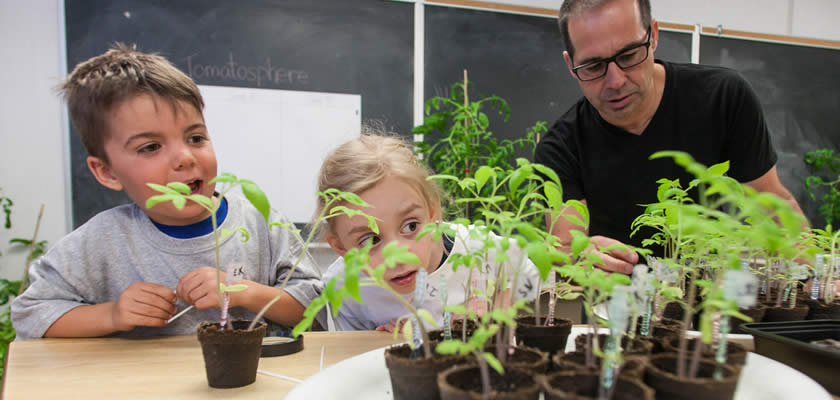
The seed planting will take 40 – 60 minutes. Teachers need to follow the instructions below to prepare (What do I need to do beforehand?) After planting of the seeds, student will observe, measure and record their observations related to the emergence of the seedlings. This takes about five minutes per day and should be done on a regular basis. Every day is best, but every other day could work if timetables do not allow daily observation.

The germination portion of the project takes approximately three or four weeks. Later, the plants may be transplanted depending upon local conditions.

Since germination MAY take place in five to seven days, it is suggested that the seeds be planted on a Wednesday or Thursday; the peat pots should be watered or misted before leaving on Friday and again on Monday.

What do I need to do beforehand?

  1. Go to the "Exploring Space - Read Me First" section in the teacher's guide. This contains an overview of the Mission to Mars and space exploration and provides links to reading activities that are grade appropriate.
  2. Helpful teacher information is found in the "Background Information for Teachers" section. Topics are varied and include the following:
    • Why Choose Tomatoes
    • What is Energy
    • Light and Photosynthesis
    • Greenhouses
    • Energy Pathways
    • Space Travel
    • Mars data
  3. An excellent starting point for “the basics” is the “Tips ‘n Tricks” section containing topcs like "Conducting the Experiment", "Germination" and "Recording and Reporting Results".
  4. Proceed to your appropriate grade area in the teacher's guide. Although the curriculum links are specific to certain grades, the three groupings provide opportunities to use the Tomatosphere Project in a range of grades, from 2-10, with different areas of focus within the three groupings. Each grade has a "principal investigation" as the focus for the activity. However, there are other areas of interest such as tomatoes, soil and energy and the appropriate curriculum connections and assessment rubrics.
  5. Purchase your peat pellets. Stokes Seeds is a partner in the Tomatosphere Project and they offer a Tomatosphere "package", available online at www.stokeseeds.com or by telephone at 1-800-396-9238. You can also purchase your peat pots locally. You will need 60 peat pots for each class that you registered. You will receive two packages of seeds, each containing approximately 30 seeds of each seed treatment involved in the experiment. You can purchase a tray for the peat pots with a clear plastic roof, creating an instant greenhouse. Be careful of an excess accumulation of moisture (humidity) that may lead to fungus growing on the soil. Simple daily ventilation of the "greenhouse" will alleviate this problem.
  6. Plan the timing of the experiment. You can start anytime after receiving the seeds. However, your colleagues have provided some suggestions to help with your planning; these includes:
    • it is a good idea to plant in the middle of the week because it usually takes 5-7 days for the first seeds to germinate. You will want your students to see this taking place.
    • try to avoid school breaks such as the traditional "March break" or religious holidays while the germination process is taking place.
  7. Review the "Scientific Method" with your students. This is illustrated and explained well in each of the grade groupings on the web site. A transparency master is provided which you can copy for the students.
  8. Arrange for a location for the peat pellets.

How do I conduct the experiment?

Details about the experiment are included on the "Conducting the Tomatosphere Experiment" page, or you can visit the teacher's guide for more detail.

What information do I collect for reporting?

Details about the recording and reporting procedures are found in the "Recording and reporting your results" page - or you can visit the teacher's guide section for the appropriate grade and obtain details at the two components following the experiment - "Observations, Collecting and Recording your Data" and "Reporting your Results".

Follow-up

If the plants remain healthy, they may be transplanted into the garden, depending upon local conditions. Details are found on the "Transplanting" page in the Tips and Tricks, and in the teacher's guide. The section on transplanting is listed as an "Extension Idea" following "The Experiment" at each of the grade level.