


Astronaut in space

Plants and light

Energy input into ecosystems

Green plants are the primary source for all of the biotic energy requirements of an ecosystem.

Photosynthesis vs respiration

In green plants both photosynthesis and respiration occur. In relatively bright light photosynthesis is the dominant process (meaning that the plant produces more food than it uses during respiration). At night, or in the absence of light, photosynthesis essentially ceases, and respiration is the dominant process; the plant consumes food (for growth and other metabolic processes).

Photosynthesis and respiration

The two processes are shown in the simplified equation above. Photosynthesis absorbs energy (from sunlight) whereas aerobic respiration yields energy (as a result of the oxidation of glucose, the carbohydrate molecule shown here).

Note that these are essentially "competing" processes, one producing glucose (photosynthesis) and the other consuming glucose (respiration).

Factors Affecting the Rate of Photosynthesis

Compensation point for light

Compensation point for light

Transparency master

One simple way to get an estimate of the level of phototsynthetic activity in a green plant is to place the plant in a sealed container and measure the rate at which oxygen is produced.

When such an experiment is actually performed it is found that increasing the brightness (intensity) of the light increases the rate of photosynthesis, but only up to a certain point, beyond which increasing the brightenss of the light has little or no effect on the rate of photosynthesis.

Conversely, reducing the brightness of the light causes a decrease in photosynthetic activity.

The light intensity at which the net amount of oxygen produced is exactly zero, is called the compensation point for light. At this point the consumption of oxygen by the plant due to cellular respiration is equal to the rate at which oxygen is produced by photosynthesis.

The compensation point for light intensity varies according to the type of plant, but it is typically 40 to 60 W/m2 for sunlight. The compensation point for light can be reduced (somewhat) by increasing the amount of carbon dioxide available to the plant, allowing the plant to grow under conditions of lower illumination.

Compensation point for carbon dioxide

Compensation point for carbon dioxide

Transparency master

Under conditions of constant and uniform illumination the rate of photosynthesis can be increased by simply increasing the amount of carbon dioxide (i.e. increasing the atmospheric partial pressure) available to plants.

As before, one can measure the rate of photosysthesis as a function of carbon dioxide pressure by placing a green plant in a sealed container and measuring the rate at which oxygen is produced.

As the partial pressure of carbon dioxide increases there is an almost linear increase in the rate of oxygen production, which implies an identical increase in the rate of phtotosythesis.

This increase eventually levels off, and further increases in the concentration of carbon dioxide have no further effect.

Conversely, reducing the carbon dioxide concentration reduces the rate of photosynthetic activity. The level at which the oxygen production rate drops to zero is called the compensation point for carbon dioxide.

A Day in the Life of a Plant

Compensation Point for Light (of photosynthetic plants) is the intensity of light at which the rate of carbon dioxide uptake (photosynthesis) is exactly balanced by the rate of carbon dioxide production (respiration) or equivalently, the light intensity at which the rate of oxygen production is exactly balanced by the rate of oxygen consumption.

Since it is primarily food production we are interested in, we will consider the third equivalency, the rate at which the food produced (carbohydrates) is exactly balanced by the rate at which the food is consumed.

In the figure to the left the red line shows the rate of carbohydrate production due to plant photosynthesis.

The green line shows the rate of carbohydrate consumption due to respiration.

The shape of the photosynthesis curve is due to increased sunlight during the day and the shape of the respiration curve is due to increased temperature during the day.

Seeds hard shell

Transparency master


Since photosynthesis produces carbohydrates, the rate at which the amount the carbohydrates change is positive for photosynthesis, that is, the amount increases.

On the other hand, respiration consumes carbohydrates, hence the rate at which carbohydrates change is negative for respiration, that is, the amount decreases.

This is shown in the graph to the left.

The area in yellow represents the total amount of carbohydrate produced in a 24h period (due to photosynthesis). The area in green represents the total amount of carbohydrate consumed due to respiration.

For a green plant to survive, grow, and produce mature fruit, area (a) (yellow), must exceed area (b) (green).

Embryonic plant forms within seed

Transparency master


The area (a), that is the total amount of carbohydrate production due to photosynthesis, can be increased in two ways:

1. Increase the intensity (brightness) of the light.

The danger is that if the light is too intense the heat it produces can damage the delicate plant cells, as well as increasing the transpiration rate, causing the leaves to wilt.

Of course, there is a limit beyond which increasing the light intensity has no significant effect on the rate of photosynthesis. This occurs for most plants at a light intensity of about 40% full daytime sunlight.

Seed begins to germinate

Transparency master

2. Increasing the duration of the light which illuminates the plant leaves.

In the case of natural sunlight it is generally not possible to increase the time during which the plants receive light beyond the length of natural daylight hours.

To increase the length of time during which photosynthesis occurs requires the use of artificial lights.

Seed begins to germinate

Transparency master

If there is enough electrical energy available both the duration and intensity of the light can be controlled to provide optimum growing conditions for green plants.

The problem is that using artificial light to grow plants is an extremely inefficient use of energy.

Seed begins to germinate

Transparency master

Things that we know about the relationship between plants and light

Things we would like to know about tomato plants

Although the maximum intensity (brightness) of sunlight on Mars is much less than on the Earth, the seasons are twice as long as on Earth. It is assumed that in the beginning all Mars habitation will occur near the Martian equator where seasonal changes are less noticeable.

Student activity: How much light?

Gro-light

Transparency master

Investigate the relationship between plant growth and the duration of available light. Begin by setting up a gro-light system on an ordinary household light timer.

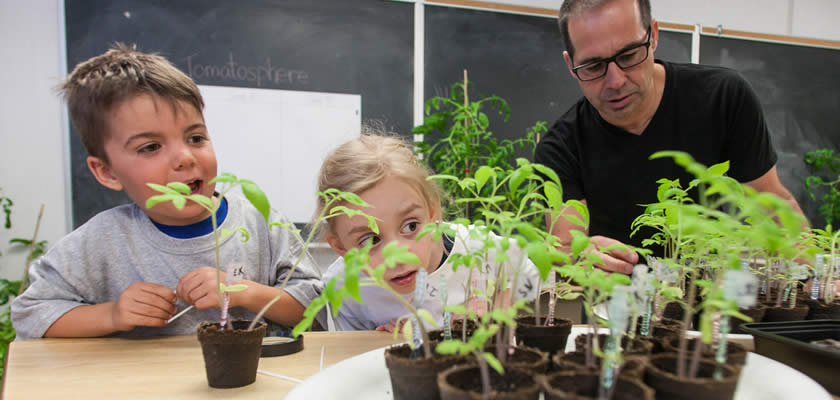
You can use your Tomatosphere seedlings for this experiment (provided that they all belong to the same group - A, B, or C).

Set up several shelves with the gro-lights above each shelf. In this investigation we will set all lights at exactly the same height above the plants, to ensure that, as much as possible, the light intensity is the same for all plants.

The variable in this experiment is the light duration, not the light intensity.

All other growing conditions must not be varied. Water, fertilize, and warm all plants identically.

Once your test site has been established, set the light timers to provide six (6), twelve (12) and eighteen (18) hours respectively.

Create a daily journal in which to record your observations.

Measure and record the following

Students look over plants under the gro-lightsDaily

Weekly

As required