


Astronaut in space

Exploring space

To the teacher

Mission to mars

The exploration of space is both exciting and challenging. The possibilities of not only visiting other planets but also colonizing them, is perhaps the most daring challenge ever undertaken by the human race.

Human exploration of space has the potential to enrich our knowledge, and provide us with resources to enrich the lives of every person on the planet Earth.

How will this be done?

Several things will be required in order to accomplish this amazing feat. It will begin with small steps. We have already reached the Moon, and the next step will be to successfully land humans on the planet Mars.

The big difference between travelling to the Moon and travelling to Mars is the distance, and hence the duration of the mission.

The technical difficulties associated with travelling to Mars will not be the biggest challenge. The ability to provide sufficient food and air for the space travellers will be among the major challenges! It is the area of human survival in space which is least understood. Human survival in space is an extremely broad field of research to which your class can contribute in an important way... here's how. A typical mission to Mars would require enough materials and food to last the crew between two and three years. Although food can be dehydrated and reconstituted with water, the crew's needs could be satisfied by growing crops, such as tomatoes.

Growing plants for food during the mission has the potential to satisfy important physical and physiological needs of the crew.

Physical Needs of the Crew

  1. Fresh food provides food energy (kilojoules) essential for human survival.
  2. Plants have the ability to extract contaminants from the water and air within the crew's living environment.
  3. Fresh produce is rich in essential vitamins and minerals necessary to maintain good health.
  4. Seeds take up far less volume than the equivalent amount of food (that they can potentially produce). If Martian water is used in a Martian greenhouse, there is also a huge saving in transportable food mass. A single seed with a mass of 1 gram might produce several kilograms of edible fruit, an important mass-saving factor for space travel.

Psychological Needs of the Crew

As anyone who has experienced a Canadian winter knows, long term confinement, isolation, restricted personal space, boredom, and the absolute predictability of everyday events is stressful. Studies have shown that growing plants and caring for other living things (e.g. pets) can reduce this psychological stress.

The care and nurture of living things alleviates boredom, provides an essential element of unpredictability or uncertainty in the outcome, provides a changing view of one's surroundings, and offers a sense of Nature in an otherwise mechanical environment.

The Unanswered Questions

When contemplating growing seeds on Mars, there are several important questions to be considered. In the 2008 version of Tomatosphere, the seeds have been exposed to increased deceleration forces and higher temperatures for a brief period to simulate the environmental conditions on the space craft as it enters Mars orbit.

The key question that you will be investigating with the Tomatosphere experiment is:

Will seeds that have been exposed to aerocapture germinate at the same, higher or lower rates than seeds which have been exposed to none of these conditions (the "control" group)?

As a class, you might consider the following questions about a Mission to Mars:

  1. If the seeds were accidentally exposed to the atmosphere of space while en route to Mars, would they still germinate? How would the germination of the seeds exposed to these conditions compare to their Earth bound counterparts?
  2. Might we need to send five times more seeds to Mars, a hundred times more... the same amount?
  3. If we assume that the conditions on the Martian surface are far too severe for ordinary seeds to germinate, a simple, low pressure Martian greenhouse would need to be built. Would seeds germinate in that greenhouse or would it be better to germinate the seeds in the space vehicle before landing?
  4. What are the advantages that might be gained from the presence of water (if it can be located) under the surface on Mars?

Tomatosphere - Your Classroom Research Project

Your class can provide scientists and mission planners with critical information by performing this scientific investigation.

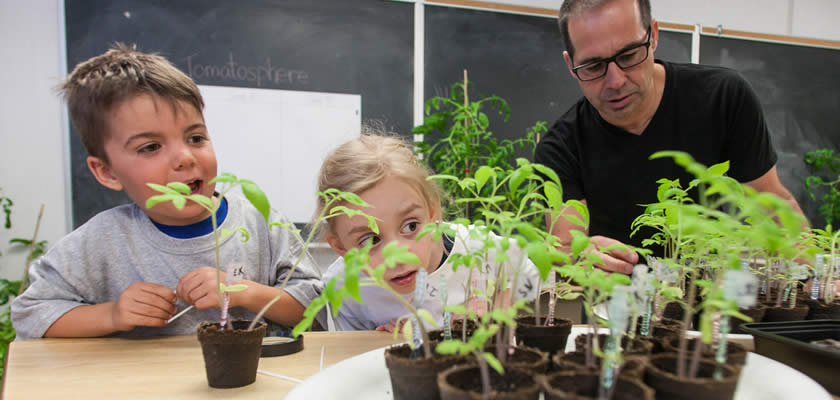
During the Tomatosphere experiment you will be asked to germinate seeds from two sources, and to report your results online at the end of the experiment (click here to submit your results online). This experiment is conducted using seeds labeled "A" and "B". When you send in your results to the tomatosphere website, you will be informed about the origin of the two types of seeds.

You will receive approximately 30 seeds in each envelope. So, for every class registered, you will receive 60 seeds. The experiments in 2008 and 2009 will lead up to the finale of this phase of The Tomatosphere Project, dealing with seeds which have been on the International Space Station.


Student activities - Reading selections

Children reading in class Children reading in class

Grades 2-4

Grades 5-7

Grades 8-10